25 August 2026
What I learnt whilst composing three new works for the Canberra International Music Festival
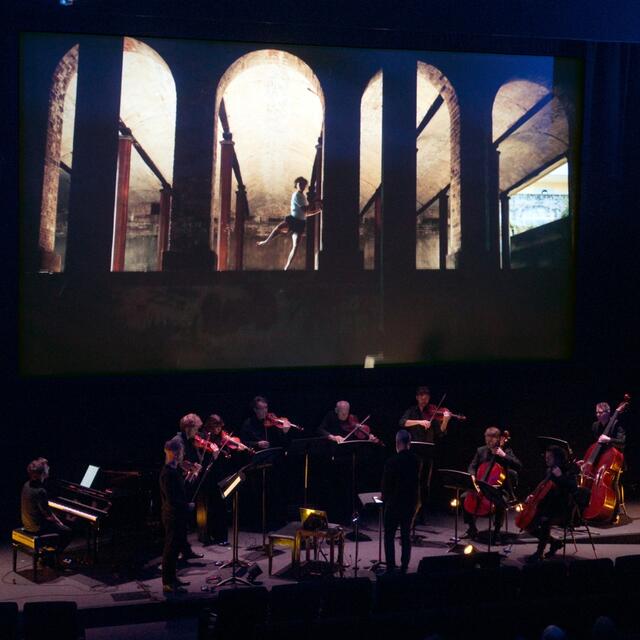 Image: Fiona Hill's 'Circumstance'. Performed by Ensemble Contrechamps and ASQ with conductor Eugene Ughetti. Visuals by Sue Healey.
 © Photo by Peter Hislop
This year in my role as Composer in Residence at the
Canberra International Music Festival I had the pleasure
of composing three new works. Whilst they all required completely
different approaches to composition, I found that through
centring collaboration at the heart of each compositional process
I was able to more deeply explore what really matters when
creating new work. As you'll discern if you read to the end of
this article (spoiler alert!) the answer is deep connection,
authenticity, and exploration through collaboration.
Two of the works, UnderOnBelow and Mappa,
featured in MOSSO: Music in Motion (a festival takeover of the
National Film and Sound Archive), while the third, If Only We
Could Listen, premiered in the festival finale at the Snow
Concert Hall, scored for two pianos and two percussionists.
UnderOnBelow began in
close collaboration with saxophonist Joshua Hyde, working
together to uncover what is possible on the instrument, then
taking those discoveries further to explore our connection with
the living, breathing earth. Joshua's openness and virtuosity
helped to shape the work, allowing me to push the instrument in
ways I never had before. Whilst the music was of course central,
we both wanted the piece to be deeply immersive experience, which
is where the visual element comes in. Working with the
extraordinary lighting and visual designer Fausto Brusamolino
brought an added layer to the work. Following ideas in David
Abram's book The Spell of the Sensuous, where Abram
talks about how we "may suddenly feel ourselves in relation with
another expressive power" when "these two senses [sight and
sound] converge", I wanted the visuals and music to be an
integral part of the whole performance experience, drawing sight
and sound together into something greater than the sum of its
parts, helping us to experience (hopefully!) a greater presence
than the solely human world. For this reason the visuals are
often abstract, yet always enmeshed with the work's underlying
concept. A focus on the natural world and what we see every day
but brought into a hyperfocus that draws our attention to the
magic before us when we truly take the time to look. Just as deep
listening brings us to that place when we truly stop to listen.
UnderOnBelow premiered as part of a portrait concert in
the Arc cinema, a programme that also featured a live performance
of Circumstance, the
multi-award winning contemporary dance film by director Sue
Healey, with members of Ensemble Contrechamps and the Australian
String Quartet.
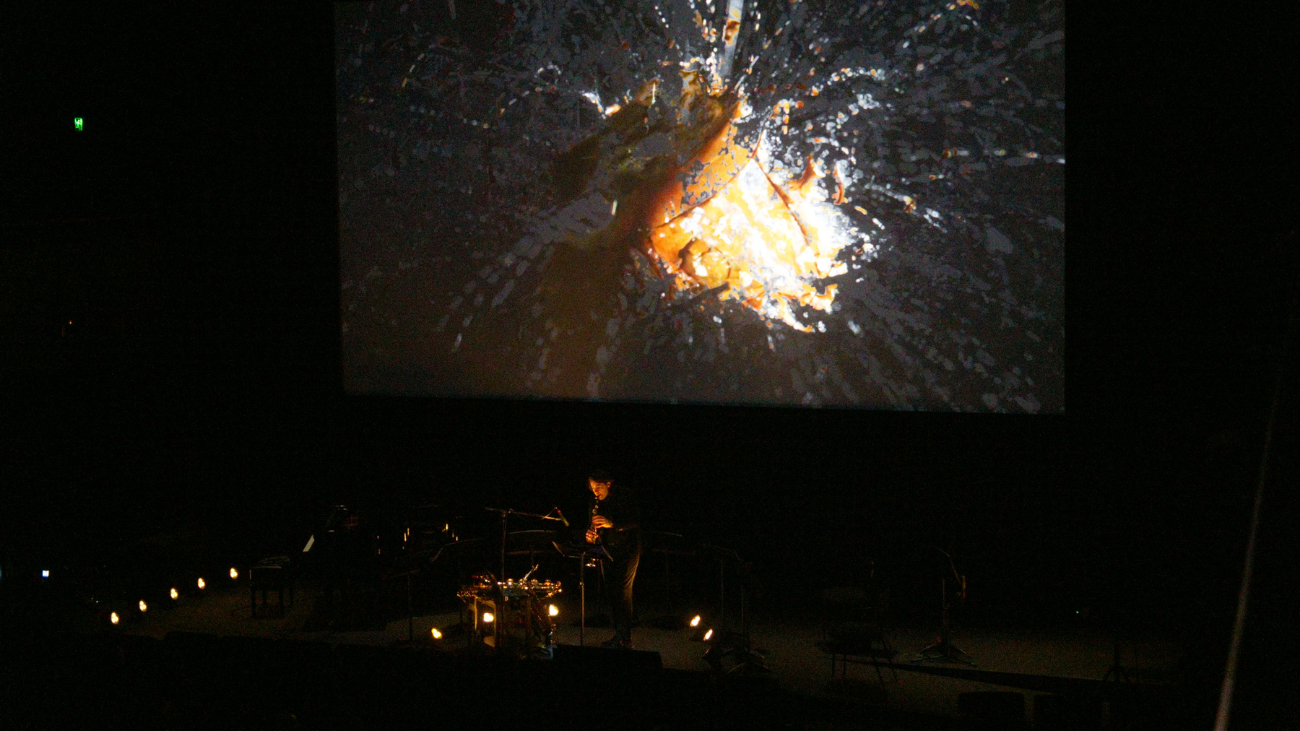
Image: 'UnderOnBelow' - Artists: Joshua Hyde (saxophone),
Frausto Brusamolino (visuals). Photo by Peter Hislop.
Mappa was the most
open and collaboratively derived work of the three (also making
it the scariest!) Mappa comes from one of earliest known
words for a map, with the first maps being thought to be drawn on
cloth, mappa being the word for napkin or cloth in
Latin. The title therefore brings together the underlying themes
at the heart of the work, the making of fabric and acts of
wayfaring. Having less strict compositional control over each
element of the music meant placing huge trust in the musicians I
was working with. Fortunately, artistic director Eugene Ughetti
and MusicACT director Sia Ahmad helped me to curate an incredible
line up of performers, bringing the wonderful local musicians
Umki and Tom Fell together with Geneva-based Ensemble
Contrechamps. Devised with contemporary dancer Miranda Wheen, the
work explores themes of women's work, drawn specifically from the
historical research of Elizabeth Wayland Barber in Women's Work
the first 20 000 years. Supported by a Bundanon residency in
early 2026, Miranda and I developed a loom-like structure that
she could dance within, until she became so entangled in it that
it came to resemble more of a spider's web that she was trapped
in, an unexpectedly emotional experience. Presented in the
gallery space at the National Film and Sound Archive, the work
invited the audience to take their time, to wander and explore as
the performance was literally built around and among them. A
sonic 'map' formed the basis of the score, offering the
performers general instructions within an overarching structure.
Within that structure they were free to improvise and interact,
encouraged towards deep listening and genuine communication with
one another and with the audience. At its centre was a
traditional weaving song from Northern England, a way of bringing
my own matrilineal heritage and connection to fabric making and
textile art into the piece.
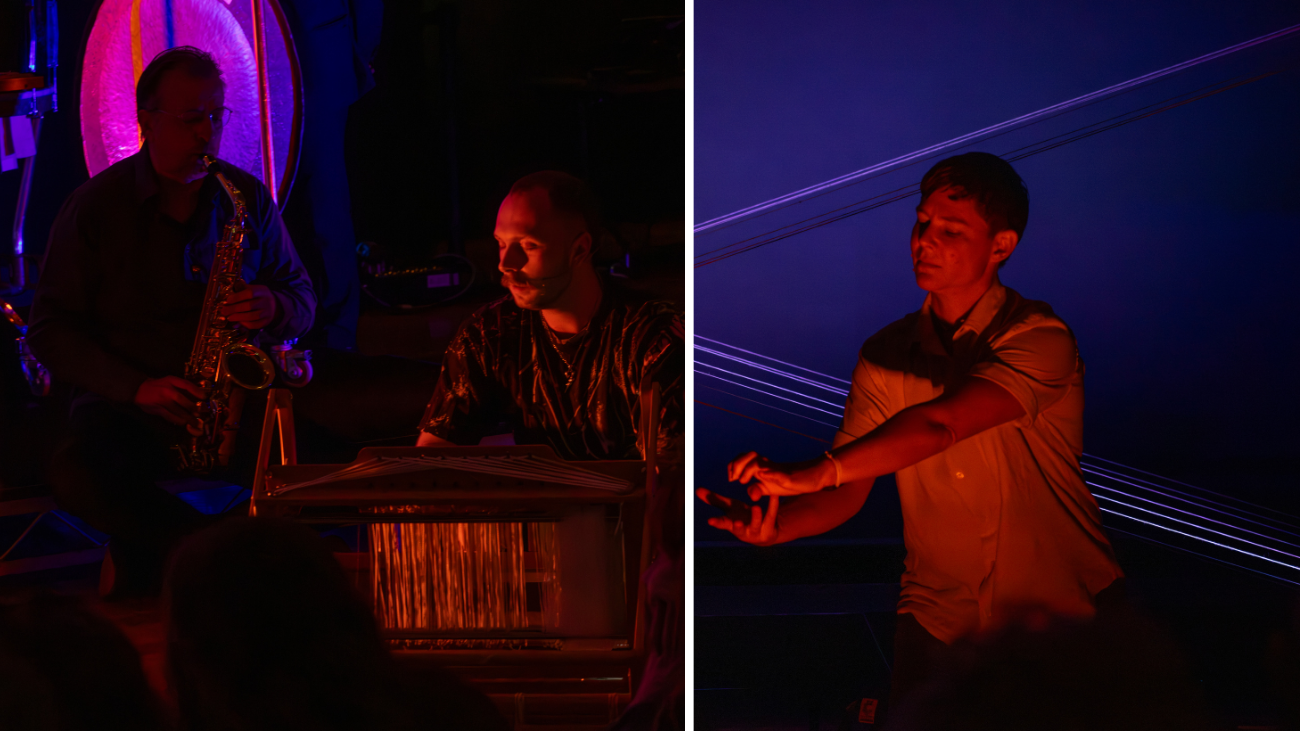
Images:'Mappa' - (L) Artists: Pierre Stéphane-Mergé (Ensemble
Contrechamps, Umiki (Lucky Wheeler); (R) Artist: Miranda Wheen.
Photos by Dalice Trost.
If Only We Could
Listen is perhaps the most traditionally composed of the
three works, drawing on the long history of repertoire for two
pianos and two percussionists that reaches back to Bartók. The
same themes of time, presence, listening and deep connection run
through it, albeit explored in different ways. The two pianists
play highly rigid material transcribed from sheet-metal factory
field recordings, anchored to the huge industrial machine they
are playing (the piano). In contrast, the percussionists move
around the stage at key moments, bringing a fluidity and freedom
that gradually influences the pianists. Eventually the machine
breaks down, and the pianists too give themselves over to a
tender, embodied exploration of their instruments. The performers
are overwhelmed once more by a frenzied macabre waltz built from
motifs of the sheet-metal factory, a reflection on the futility
and tragedy of progress at all costs. Ultimately the musicians
are asked to connect deeply with one another, finding new ways to
engage with their instruments that physically bring them
together, while ghostly fragments of the machinery sound in the
background through transducers attached to a tam-tam and timpani.
Whilst there is a certain amount of programmaticism to the work,
the deeper intention is to explore the ways we might connect and
engage as performers in a traditional concert setting, allowing
the embodiment of performance to help us ask difficult questions
as a society. What would be possible if we could all truly
listen? Not just to ourselves, but to the more-than-human world
that we share.
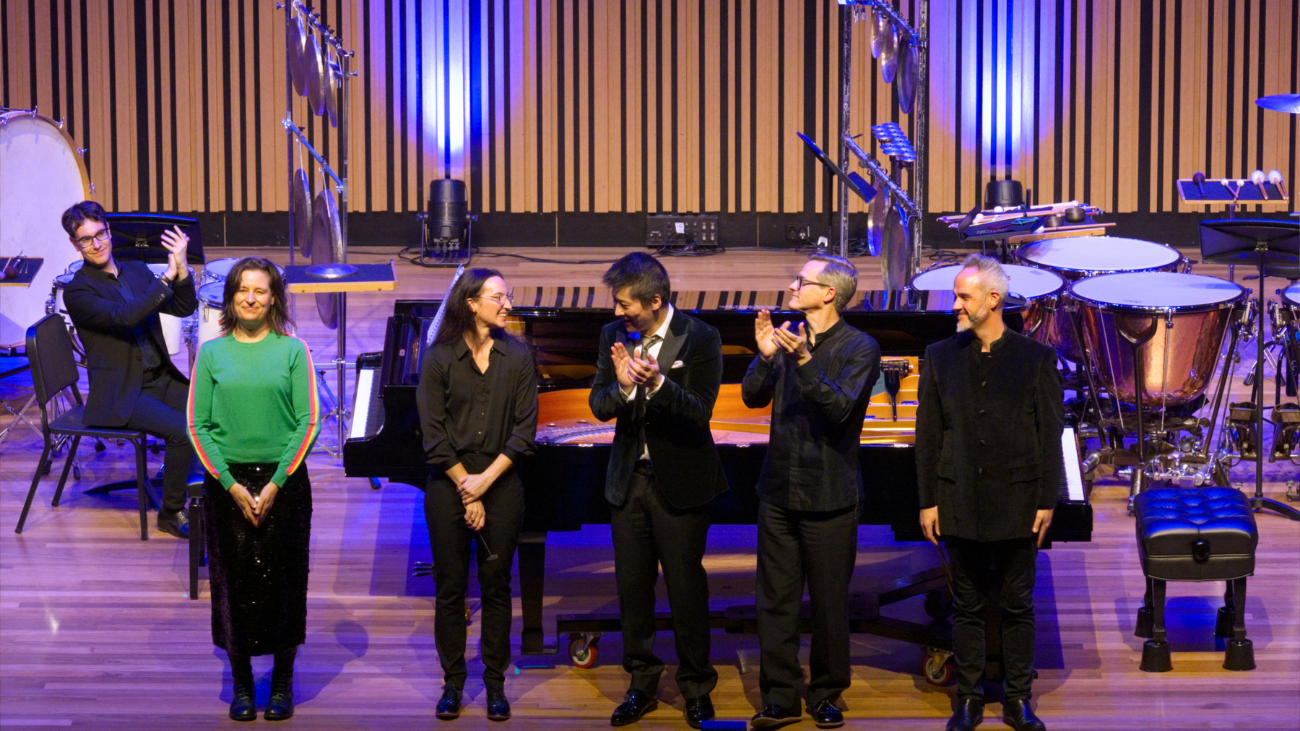
Image: 'If Only We Could Listen' premiere Snow Concert Hall.
Artists: Dante Costa (page turner), Fiona Hill (composer), Kaylie
Melville (percussion), Kristian Chong (piano), Timothy Young
(piano), Eugene Ughetti (percussion).
As a composer, I am incredibly grateful to have three such varied
platforms for my work within a single festival. Huge thanks to
Artistic Director Eugene Ughetti and the entire Canberra
International Music Festival team for their wonderful commitment
and vision! A portfolio career often means that one month I am
writing for contemporary dance, the next for film, the next for
the concert hall. What this residency offered was the chance to
let those aspects overlap. Across all three works I found myself
returning to the same threads: deep listening and presence,
authentic collaboration, and an exploration of our connection and
responsibility to the living earth. Bringing film, dance,
improvisation and notated concert music into a single
conversation is, for me, where the real discovery lies. Perhaps
it's also where the longevity of contemporary art music can be
found. As I heard the wonderful percussionist Pirashanna
Thevarajah say at a performance talk recently, "it's all just
music", a reminder for us to let the boundaries that classify and
divide music blur, allowing for deeper connection between
artists, audiences and the living world that we are all a part
of.
The scores for all three works are available to purchase through
the Australian Music Centre. You
can explore more about these projects and my wider practice at
fionahill.net
© Australian Music Centre (2026) — Permission must be obtained from the AMC if you wish to reproduce this article either online or in print.
Subjects discussed by this article:
Fiona Hill is a composer specialising in electroacoustics and immersive sound. Described as having 'powerful emotional impact' (The Advertiser), she often explores the dichotomy between the natural and industrial worlds, attempting to find the beauty and resilience of the human psyche where worlds collide. She is lecturer in Composition for Creative Industries at the University of Sydney Conservatorium of Music, serves as Chair of the Education sub-committee of the Australian Guild of Screen Composers and is a represented artist with the AMC.



Comments
Be the first to share add your thoughts and opinions in response to this article.
You must login to post a comment.