15 October 2026
Beyond a Bio: Robert Davidson
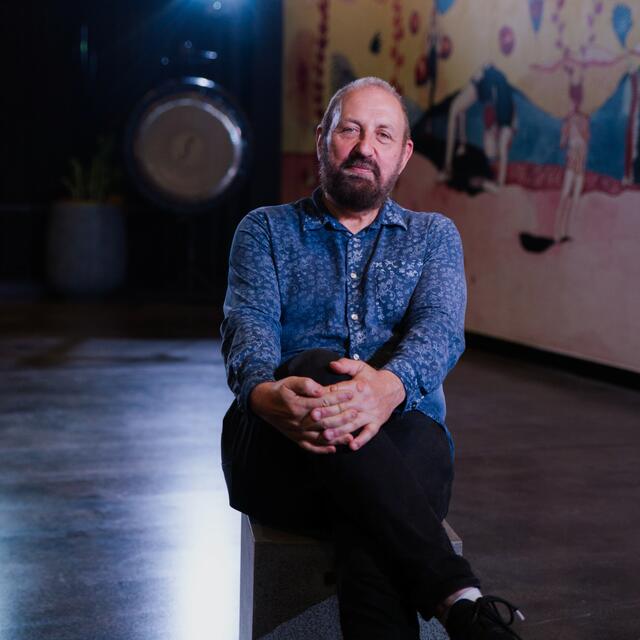 Image: Robert Davidson
Robert Davidson is
a prolific composer, bassist, lecturer and founder and artistic
director of Topology. Davidson studied composition with Terry
Riley in California before completing a composition PhD at the
University of Queensland. He previously studied South Indian
vocal music in Kerala, India.
Davidson's compositions are regularly performed,
recorded
and broadcast
around the world, in venues including New York's Lincoln
Center, Sydney's Opera House and London's Barbican. All of
Australia's professional orchestras and many leading soloists
and ensembles have commissioned and performed his works. With
Topology he has released 14
albums, and has directed numerous
artistic collaborations with creators of many varied cultural
and stylistic backgrounds, including The Saints, Geoffrey Rush,
Terry Riley, The Brodsky Quartet, Katie Noonan, Kate
Miller-Heidke, Christine Anu, TaikOz,
William Barton and many more. He has scored three documentary
films: Memory Tree (Juniper/ABC), Joyride (Fifty Fifty/ABC,
2018), and Strong female lead (Northern Pictures/SBS, 2021),
and dance scores for the Queensland Ballet and Expressions
Dance Company.
Now, let's move Beyond a Bio
to find out more about Robert's creative process.
How would you describe your music to someone hearing it for the first time?
My music tends to be focused on lyrical melody - my aim is to make music that is memorable and relatable, while also presenting some challenges and surprises. I place a lot of trust on intuition, and on coming up with melodies in an almost unconscious and unstudied way, the way most 3-year-olds seem to. I also have been fascinated my whole life with the music of spoken language, so I often take melodic cues from how people speak (often very directly by using actual recorded speech). I enjoy some humour in music, and having lots of associations and references (where copyright allows). Stylistically, there are certainly traces of my studies with minimalist pioneer Terry Riley, as well as my collaborating with colleagues from many other cultures (espcially various Tibetan, Indian, Indonesian and Chinese traditions), and within Western culture but in genres outside my classical focus - jazz, rock, country, folk, EDM and progressive musicians for example.
How does a new work usually begin for you?
It varies. I am constantly keeping scraps of ideas written in prose, notated, recorded, or drawn in notebooks, on backs of receipts, boarding passes, in voice memos on my mobile, on my computer etc. These are melodies, little riffs and rhythms, chord progressions, but also more abstract concepts, often through asking "what if..." or by noticing things while out walking or chatting to people. One piece I'm really pleased with is We Apologise and that started with a very vague concept (while chatting with friends at a cafe) that gradually came into focus, by combining a number of different ideas.
What ideas or sounds are inspiring you right now?
The birds on my balcony and back yard, especially the stone curlews. I'm also jamming every week with my good friend Tenzin Choegyal, and that is inspiring me a lot to make music from the heart, as he does so well. My partner Jackie Marshall's music is also inspiring me to be direct and fully myself, as she is.
Can you tell us about a recent project or work?
I have been very pleased with my ongoing project The Carnival of Extinct Animals, composed for Anna Grinberg and Liam Viney. In it, I've taken archival recordings of animals now extinct (the recordings were made before extinction) and made musical frames for these sounds, which closely follow the melodies and rhythms of their sounds. It's a kind of celebration but also lament. To bring some hope to the project, I decided to include some animals that are not extinct, but endangered - where there is hope of bringing them back from the brink (like the Sumatran Rhinoceros). It's one of the most urgent issues of our time, in my opinion, though of course we have many urgent issues. In tribute to Saint Saëns' delightful composition, I have a few allusions to his style peppered through the work. I've been composing numbers for the collection since 2021 and am continuing with new pieces from time to time - the next one involves Winton dinosaur footprints that my friend Anthony Romilio, a leading dinosaur expert at UQ, has worked out the timing for, so I can create rhythms for Anna and Liam to play.
What do you hope listeners experience in your music?
I hope they enjoy the music, and find themselves emotionally moved, and perhaps intellectually stimulated too. I do like including aspects for very advanced and perceptive listeners (and I'm tickled when they notice those things), but my main aim is to make music that can be appreciated without a lot of experience of contemporary classical music, while also being within that general area of music. I don't think I'm pandering; I'm writing the music I want to hear. I agree with Steve Reich, in what he told William Duckworth: "I compose what I want to hear. If I love it, maybe you will too." But if you don't, that's fine; there's plenty of other music to hear.
Where or how do you work best?
It depends on the mode of composing. For me there are five: planning, creating, selecting, developing and finalising. For planning, I work best at a desk. For creating, I seem to do best either while moving my body (walking, cycling, kayaking, going in vehicles) or while waiting (in queues, waiting rooms, or backstage waiting to play a concert), or late at night waiting to go to sleep (that is annoying though since I am trying to get to sleep), or at concerts (see more below). For selecting, developing and finalising, I like being in my own studio (mostly at the piano or computer) or office.
What's something people might not expect about your creative process?
I get many ideas when going to concerts. I hasten to add that that's not through plagiarising. It just seems to be very stimulating to be in a live concert seeing people play music: it sparks ideas. Sometimes it's "oh I like that - I could do something related" or "oh I would have done this instead".
If you had to name one Australian work everyone should hear, what would it be?
Ngapa William Cooper by Lou Bennet, Lior and Nigel Westlake. It's a beautiful, significant, meaningful and very powerful composition that tells a very compelling Australian story that is important for all of us.
What excites you about Australian art music right now?
There is a lot of music that grapples with really meaningful subjects and does so with humanity, beauty, depth and imagination. We really are in a great period for extraordinary work. I meet regularly with very diverse composers in Brisbane and there is a strong sense of supportiveness and deep engagement, while embracing a wide diversity of styles and approaches; to me this is very healthy indeed. I also love seeing deep collaborations, like Ngapa William Cooper, or the many other cross-genre, cross-artform and cross-cultural collaborations leading to fantastic music.
What's next for you?
I'd like to write a series of pieces about specific bridges: their shapes, stories, meanings, sounds and functions. I'm also adding to my Carnival of Extinct Animals and other ongoing projects.
© Australian Music Centre (2026) — Permission must be obtained from the AMC if you wish to reproduce this article either online or in print.
Subjects discussed by this article:
- Robert Davidson (Interviewee)
- Carnival of Extinct Animals by Robert Davidson
Beyond a Bio is the AMC's interview series shining a spotlight on composers and creators, giving audiences an insight into their creative process, current work and the art music community in general.



Comments
Be the first to share add your thoughts and opinions in response to this article.
You must login to post a comment.